When does Simpler Recycling start for micro-businesses?
Micro-businesses in England (businesses with fewer than 10 full-time equivalent (FTE) employees) have until 31st March 2027 to comply with the Simpler Recycling workplace requirements. In practical terms, businesses should prepare to separate their waste into food waste, glass, dry mixed recycling and general waste, in line with UK commercial waste collector guidance. The Government has also announced that mandatory collection of plastic films and flexible packaging will be delayed until 1st April 2030.
If you run a small business, you may have heard about Simpler Recycling but still be unsure about what the legislation means for you.
The rules have already come into force for larger businesses (10+ FTE employees), but micro-businesses have been given an additional two years to prepare. With the deadline approaching, now is a good time to understand what your waste setup needs to look like to be compliant.
What is Simpler Recycling?
Simpler Recycling is a set of waste regulations designed to make recycling more consistent across England by requiring workplaces to separate recyclable and food waste from non-recyclable waste.
The workplace rules came into force on 31st March 2025 for businesses with 10 or more full-time equivalent employees, but micro-businesses (those with fewer than 10 FTE employees) have until 31st March 2027 to comply.
For businesses, the requirements cover separating:
- Dry recyclable materials, including plastic, metal, and glass
- Paper and card
- Food waste
- Non-recyclable or residual waste
This is in accordance with the current Government requirements.
When does Simpler Recycling start for micro-businesses?
Micro-businesses have until 31st March 2027 to comply with the workplace Simpler Recycling requirements.
A micro-business is a business with fewer than 10 full-time equivalent employees.
The employee count applies across the whole business rather than being calculated separately for each premises and location. For example, a business with three locations and five employees at each has 15 employees in total and would not qualify as a micro-business.
The key dates are:
| Business type / waste stream | Deadline |
| Businesses with 10+ FTE employees | 31 March 2025 |
| Micro-businesses with fewer than 10 FTE employees | 31 March 2027 |
| Plastic films and flexible packaging | 1 April 2030 |
The flexible plastics date is a recent change. As of 16th July 2026, the Government have announced that the mandatory collection of plastic films and flexible packaging is delayed from the original 2027 timeline until 1st April 2030.
How does Simpler Recycling support the circular economy?
Simpler Recycling is also part of a much bigger change in how England uses and manages its resources.
The Government is working towards a zero-waste,circular economy, here materials are kept in use for longer rather than being used once and thrown away. The aim is to reduce waste, cut greenhouse gas emissions, support green jobs and infrastructure, and make better use of the resources already in circulation.
Simpler Recycling is one part of this wider strategy, alongside reforms such as Extended Producer Responsibility (EPR)for packaging and the Deposit Return Scheme (DRS) for drinks containers.
Together, these measures are intended to help England reach its ambition of recycling 65% of municipal waste by 2035.
By making recycling requirements consistent, Simpler Recycling aims to make recycling in the workplace easier to understand. This should then help increase the amount of high-quality recycled materials that can be reused within the UK and contribute to our circular economy.
Knowing why the legislation is changing is only half of the Simpler Recycling story. You also need to know what your business will need to do before the 31st March 2027 micro-business deadline.
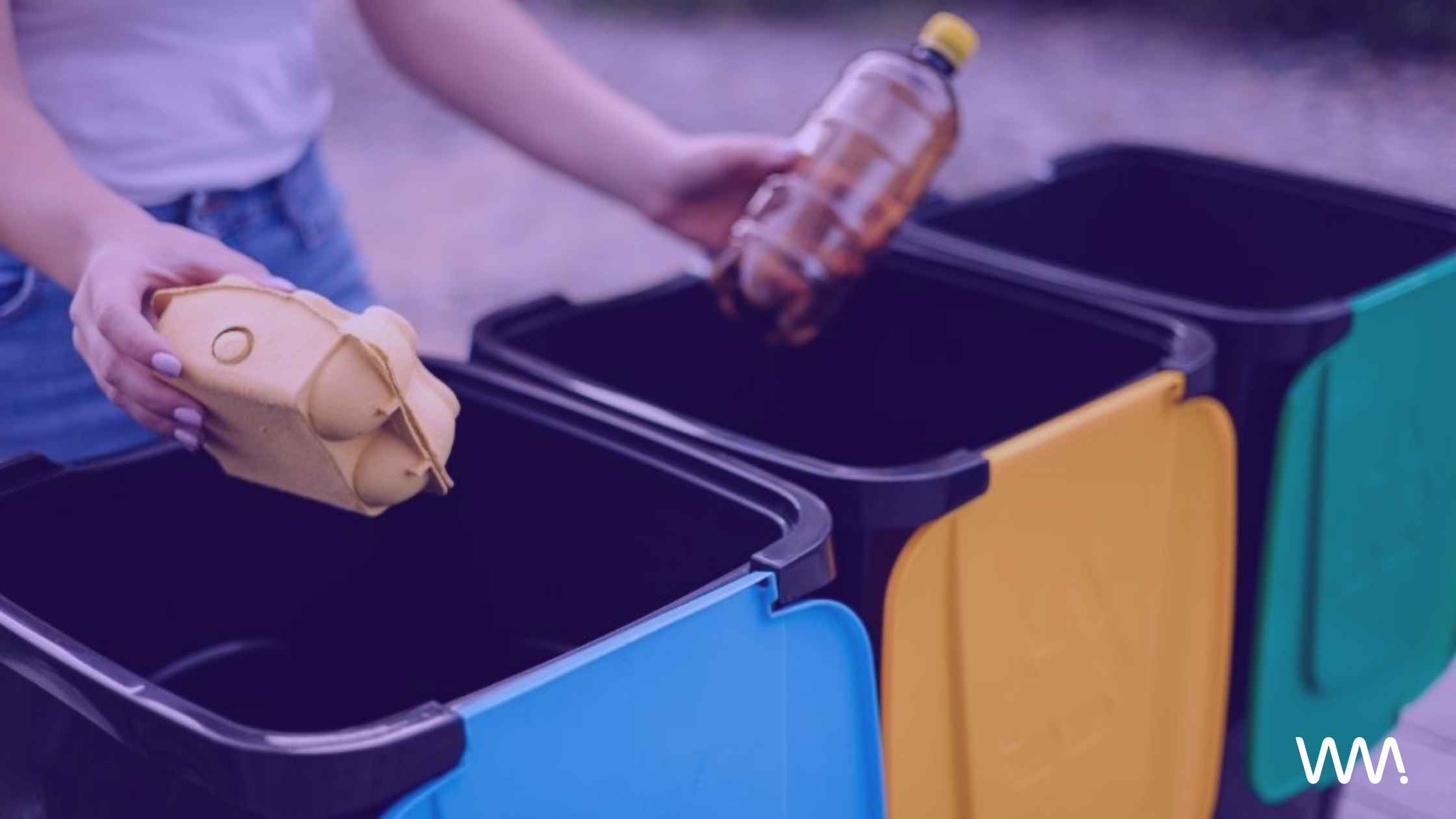
How should waste be separated for Simpler Recycling?
The Government’s workplace Simpler Recycling guidance sets out the dry recyclable materials, food waste and non-recyclable waste that need to be separated, while commercial waste collectors determine the practical collection arrangements needed. Depending on your supplier, this may see further separation being needed to comply with their Simpler Recycling processing.
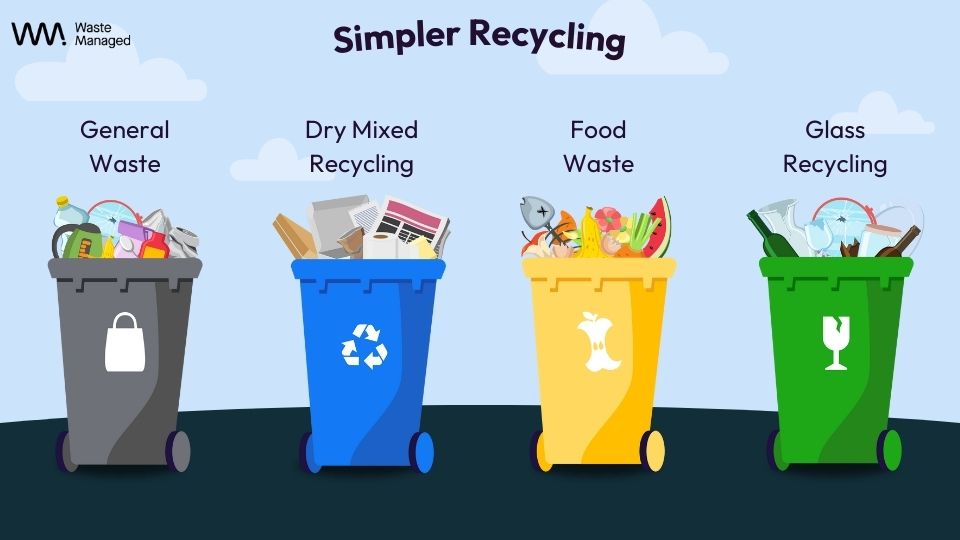
For businesses using a commercial waste collection service, the practical approach is to separate waste into four key streams:
The exact bin volumes and collection frequencies you need will depend on the type and amount of waste that your business produces.
The following groups together the Government Simpler Recycling rules and current UK supplier guidance:
1. Food waste
Food waste needs to be kept separate from recyclable waste streams and needs to be placed into a dedicated food waste bin.
Food waste might look like:
- Food preparation waste such as fruit and vegetable peelings
- Leftovers or plate scrapings
- Coffee grounds
- Food that has spoiled or past its use-by date
Keeping food waste separate helps prevent it from contaminating other recyclable materials. This means that the recyclable items can be sent for appropriate treatment.
Even if your business only produces a relatively small amount of food waste, it is worth considering how this will be stored and collected once the rules apply.
2. Glass
Glass needs to be separated from other dry mixed recycling waste if your commercial waste collection service requires this. Your supplier will provide a dedicated glass stream container if so.
Glass waste can include:
- Glass bottles
- Glass jars
- Other accepted glass containers
Separate glass collections are important in helping prevent broken glass from contaminating other recyclable materials.
This is particularly relevant for businesses such as restaurants, cafés, pubs, hotels and other hospitality premises, where glass can make up a significant proportion of the waste produced.
3. Dry mixed recycling
Dry mixed recycling (DMR) is the term for clean and dry recyclable materials that can be put together in the same waste stream.
Depending on your commercial waste collection provider, this will look like:
- Metal: food tins and drinks cans that are empty, clean, and dry; aluminium foil and food trays and tubes that are clean and dry; empty aerosols such as deodorants and air fresheners
- Plastics: plastic food containers and bottles and cartons, including pots, tubs, trays and tubes, that are empty, clean and dry
- Paper and cardboard: newspapers, boxes, clean cardboard food packaging, envelopes
- Glass: however, UK suppliers are requesting that this be separated from DMR due to the risk of broken glass contaminating this waste stream.
It is important to check exactly what your waste collector will accept as part of their dry mixed recycling collection service and whether glass needs to be separated.
4. General waste
General waste is waste that cannot be recycled as part of dry mixed recycling, glass or food waste. This is also called non-recyclable waste or residual waste.
Non-recyclable waste most often looks like:
- Soiled cardboard such as pizza boxes and take-out containers
- Non-recyclable plastics and crisp packets
- Polystyrene such as Styrofoam blocks from delivery packaging
- Dirty paper towels and tissues
- Vacuum clean bags
Simpler Recycling cannot eliminate general waste completely. But it can aim to significantly reduce the amount of waste that reaches landfill. Businesses can support this by removing their recyclable and food waste from their general waste stream to support these materials being appropriately recycled or treated as much as possible.
The less recyclable material that goes into general waste, the more of your waste can potentially be diverted away from landfill disposal.
What does Simpler Recycling mean for a micro-business?
For a micro-business, you need to review your current waste set-up and make sure it is compliant under both the Government’s and your waste collector’s Simpler Recycling guidelines. The basics are to make sure you have the correct containers to separate dry mixed recycling, food waste and general waste before the 31st March 2027 deadline.
A good place to start when addressing the volume of containers needed is by looking at what your business actually throws away.
Here are our 7 top questions to ask yourself:
- How much food waste do we produce?
- Do we generate glass waste?
- How much dry mixed recycling do we have?
- How much general waste is left?
- Are recyclable materials currently ending up in general waste or are they separate?
- Are our current bins the right size to cater for Simpler Recycling separations?
Are our collection frequencies suitable for each separate container?
Once you understand the amount of waste that your business produces, you can choose the most appropriate sized bins and collection frequencies for your business.
How can a micro-business prepare for Simpler Recycling?
The easiest way to prepare is to review your current waste set-up against the Government guidance, check your waste collector’s Simpler Recycling separation needs, and make sure your staff know how to separate each waste stream. We recommend using a waste management service, because they can help you do all of this.
1. Review your current waste production
Check how much waste your business produces over a typical week.
You might be surprised by how much dry mixed recycling you produce, or how much of your general waste can actually be placed into food or glass streams.
2. Check your waste collection
Speak to your current waste collector or waste management service and ask whether your existing set-up will meet the Simpler Recycling requirements from 31st March 2027. You might just need to add separate food and glass bins to get compliant.
3. Make it easy for staff
Getting the right set-up is only part of Simpler Recycling. Teaching your staff exactly which items need to go into the correct waste stream will help you to make sure you are fully Simpler Recycling compliant.
If staff are unsure where something should go, it is more likely to end up in general waste in a moment of panic.
Simpler Recycling training in the lead-up to 31st March 2027, alongside clear labels, signage and posters, will help make the process for your staff much easier. Keep an eye out for the free educational content on Simpler Recycling on our Waste Managed LinkedIn that you can use to share with your staff.
4. Review your waste before the deadline
Save yourself the stress and get Simpler Recycling compliant before the 31st March 2027 deadline.
Reviewing your waste arrangements early gives you time to:
- Make sure you have the correct bins for both the Government and your waste collector guidance
- Train staff on the correct separation processes
- Reduce unnecessary general waste
What about plastic films and flexible packaging?
The mandatory collection of plastic films and flexible packaging has been delayed until 1st April 2030.
The most common types of plastic films and flexible packaging are:
- Monolayer Polyethene (PE) film: This looks like carrier bags, bread and cereal packaging, bubble wrap and frozen food bags.
- Polypropylene (PP) Film: Businesses will commonly see this in the staff kitchen in the form of crisp pac[LC1] [SR2] kets and biscuit wrappers. If you’re a florist, did you know that this type of plastic is what makes up your flower wraps?
- Multi-layer Laminated Materials (Complex Films): Again, businesses will commonly see this type of plastic in the staff kitchen, as it’s what coffee bags and microwave-ready meal pouches are made from.
This delay is to give waste collectors and the recycling industry more time to develop the collection, sorting and processing infrastructure needed to deal with flexible plastics at such a scale.
We will keep this page updated with live Simpler Recycling news such as this.
Does Simpler Recycling apply to micro-businesses with multiple locations?
Yes. To be classed as a micro-business in England, there needs to be fewer than 10 full-time equivalent (FTE) employees in total across all your business locations. The total figure is based on the total number of employees within the business, not on the number of employees at each location.
For example, if a business has two premises and five full-time employees at each location has 10 employees in total, this means that there are 10 employees so the business would not qualify as a micro-business.
This definition of a micro-business is particularly important for businesses that are planning to grow or operate from multiple premises before 31st March 2027. If you are close to the 10 FTE employees threshold, make sure to assess your waste set-up soon to become Simpler Recycling compliant as soon as possible.
If you previously thought that your business was a micro-business but now understand that your staff calculation has hit the 10+ threshold, you’ll need to make sure that you’re Simpler Recycling compliant now. If you’re not, make sure to contact your waste management service, who will quickly help you become compliant.
What happens if a micro-business does not comply with Simpler Recycling?
Micro-businesses have until 31st March 2027 to comply with the workplace requirements.
After this date, all businesses in England, regardless of staff count, must make sure that waste is separated and collected in adherence to both the Government and their waste collector guidance.
If a micro-business is found not to be complying with the new Simpler Recycling rules, the Environment Agency (EA) could issue a compliance notice. It is an offence to fail to comply with a compliance notice, and enforcement action may follow.
That’s why we recommend that all micro-businesses get Simpler Recycling compliant as soon as possible before the deadline, so EA enforcement doesn’t need to become an issue.
Is it too early to prepare your micro-business for Simpler Recycling?
No. That’s because preparing early can take the stress out of transitioning to better recycling practices for your micro-business.
You might not need a drastic change to your current waste management set-up to become compliant. That’s why we recommend that your micro-business start the Simpler Recycling process by understanding what you currently throw away and where your existing collection service could be improved.
This is especially useful if your business:
- Does not currently separate food waste from general waste
- Groups together glass and dry mixed recycling
- Produces significant food or glass waste
- Currently relies heavily on general waste
- Incurs general waste overweight charges
Getting your Simpler Recycling arrangements sorted early not only gives staff time to get used to separating waste correctly before the legislation applies to your business, but it also could reduce your overall waste management costs too.
Make sure to get in touch with your waste management service or waste collector to see if you can get Simpler Recycling compliant and cost-effective as soon as possible.
Check Your Knowledge: Simpler Recycling for Micro-businesses
- Micro-businesses have until 31st March 2027 to comply with the main workplace Simpler Recycling requirements.
- A micro-business has fewer than 10 full-time equivalent employees.
- Employee numbers are calculated across the whole business and are the total number of staff for all locations the business owns.
- Businesses should be prepared to separate food waste, glass, dry mixed recycling and general waste in line with the Government rules and their waste collector guidelines.
- The separation of plastic films and flexible packaging has been delayed until 1st April 2030 for all businesses in England.
- The Environment Agency (EA) can issue a compliance notice to any businesses failing to be Simpler Recycling compliant after 31st March 2027.
- Your waste management service or waste collector will help you with everything you need to become Simpler Recycling compliant.
- Reviewing your waste arrangements early gives you time to train your staff on correct separation processes, lessens the risk of non-compliance by the due date, and may make your waste management costs more efficient.