
Understanding common bin sizes
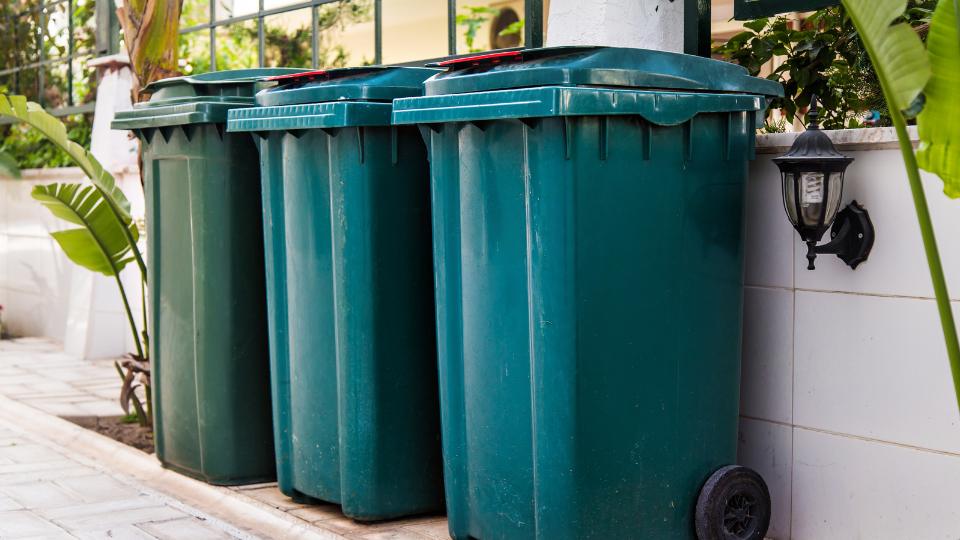
The most common commercial bin sizes which are available through Waste Managed, are designed to fit into most types of businesses and waste volumes.
Bin sizes 240L, 660L, and 1100L bins are the most commonly used commercial bin sizes.
240L
A 240L wheelie bin is usually suitable for businesses who produce smaller amounts of waste, such as salons and small retailers.
660L
The 660L bin is the most popular mid-sized option, offering more wheelie bin capacity for businesses with an average waste output, such as butchers and bakeries.
1100L
A 1100L wheelie bin is the largest option, providing the most commercial waste bin capacity. These are fit for businesses with a high waste output, such as restaurants, hotels, and the health sector.
360L
Another option available is a 360L wheelie bin, which is also available in certain locations where businesses may need slightly more waste capacity than a 240L bin but have limited storage space.
There are 3 common bin sizes available for free rental & delivery with Waste Managed.
These are the 240l, 660l & 1100l commercial bins. The 360L is only available in certain locations.
Key Considerations
When you are choosing between different commercial bin sizes, it is super important to consider multiple factors. These should include:
- Your waste volume
- The amount of storage space available on your site
- The frequency of collections
Some businesses will have fortnightly waste collections or higher waste output, which means they may require a larger commercial waste bin to help stop overflowing.
Before you select a bin size, you should also ensure you choose the right waste type. If your bin is cross-contaminated, the waste collectors can refuse to pick up your bin. Mixing different waste streams can now result in rejected loads and additional charges due to the simpler recycling legislation.
The Bin Size Calculator
To help businesses estimate the most suitable bin size for their waste needs, we have a wheelie bin size calculator. We consider factors including waste volume and collection frequency; we will recommend the right wheelie bin size for you, which then helps you figure out if it is the right fit for your available storage space.
The Bin Size Calculator
Typical wheelie bin sizes by business type
If you don’t know what your likely waste output is, it can be helpful looking at the bin sizes most commonly used by your sector and other business types. Waste requirements often vary depending on:
- The sector
- The number of staff/customers
- The type of waste stream
For example, businesses that mainly generate small amounts of dry mixed recycling will usually require a smaller bin than other businesses that produce a higher volume of dry mixed recycling.
Businesses most suitable for 240 Litre bins
A 240 Litre bin is usually picked by smaller businesses with a lower waste output. This size is typically suitable for small offices, independent shops, and salons. The waste volumes are small, which means collections can be managed accordingly to mirror the time it takes to fill up the bin.
Businesses most suitable for 660 Litre bins
A 660 Litre wheelie bin is the most popular, mid-sized option, often used by businesses that produce average amounts of waste. Including offices with larger-sized teams, pubs, and cafes. It provides more capacity than a 240L without taking up as much room as the larger bins.
Businesses most suitable for 1100 Litre bins
1100 Litre bins are for businesses that generate significantly higher volumes of waste. This wheelie bin size offers the largest standard capacity for waste and is commonly used by restaurants, hotels, and supermarkets, where large amounts of waste are generated every single day.
Understanding common waste types
Different types of waste require different handling, storage and disposal methods, and by understanding what correctly falls into each category can help businesses stay compliant, reduce environmental impact and manage waste more efficiently. Here is a simple guide to the most common waste types and what they include.
General waste
General waste includes items that cannot usually be recycled, such as non-recyclable plastics, contaminated packaging, wet or food-soiled cardboard, used tissues, and disposable wipes. Items such as coffee grounds and tea bags that cannot be separated for food recycling, may also fall into this waste type. General waste is typically collected in dedicated commercial bins and sent for treatment or energy recovery.
Dry mixed recycling
Dry mixed recycling refers to typically recyclable items that can be collected in one bin. This includes paper, cardboard packaging, juice cartons, metal drink cans, plastic bottles (that have been rinsed out so there is no residue left), newspapers, magazines, and paper bags.
Food waste
Food waste includes organic waste produced by businesses like kitchens, cafés, and hospitality venues. This can include fruit and vegetables, dairy products, breads and pastas, leftover food scraps, and Eggshells. This can be turned into compost or energy to be used around the UK.
Glass waste
Glass waste usually consists of drink bottles, jars and food containers used in places like restaurants, pubs, and cafés. Broken drinking glasses or glass containers may also be included, depending on collection guidance.
Clinical waste
Clinical waste is waste typically produced by healthcare and medical environments. This includes items such as bandages, dressings, expired medications and other materials that may have come into contact with bodily fluids.
Sharps waste
Sharps waste includes everything from pharmaceutical implements like hypodermic needles, scalpels and insulin pens to more common sharp objects like razor blades, pins, staples and scissors, which are commonly produced in the health care sector and tattoo parlours.
You can find out about all waste types in our handy guide.
What our experts say
“Choosing the right size can make a big difference to how efficiently your business manages waste. Many businesses either underestimate or overestimate their waste volume, which can lead to overflowing bins or paying for additional collections.
That’s why it’s important to pick the correct commercial wheelie bin size. At Waste Managed, we work closely with businesses to understand their waste volume and the rate at which it is being generated, so we can recommend the best-suited waste bin and collection frequency that fits their daily operations. Having the correct waste streams in place makes it easier for businesses to keep their sites clean and running smoothly.” – Glen Darrel (Head of Commercial)
Choose the right size wheelie bin for your business
The most common commercial wheelie bin sizes used by businesses are 240L, 660L and 1100L bins. Each size is designed to suit different levels of waste output, from smaller businesses to larger ones.
If you are already producing waste, you can enter the number of waste bags you produce weekly and the waste type into our bin size calculator above and receive a recommended bin size.
This helps estimate your ideal wheelie bin size so you can manage your waste safely while remaining within weight limits. If a bin is over the weight limit, the collection may be refused, so it’s very important to make sure you have a big enough bin.
240 Litre Bin Specifications
The 240l two-wheeled bin is perfect for smaller businesses that have a low waste or recycling output.
Here’s a breakdown of our 240L bin hire and collection service specs & features:
- Ideal for: Businesses generating 4-5 bags of waste (of any type) between collections.
- Collection Frequency: Choose weekly, fortnightly, or monthly collections to fit your waste volume.
- Bin Capacity: 240 litres, which holds roughly 5 full bags of waste.
- Accepted Waste Types: General waste, dry mixed recycling, food waste, glass waste, and even clinical waste (with special bins).
- Lid Security: Most wheelie bins have non-lockable lids, except for those designated for clinical waste.
- Mobility: All wheelie bins come with 2 wheels for easy manoeuvring.
240 Litre wheelie Bin Dimensions
By choosing the right wheelie bin size and collection frequency, you can streamline your waste management process and avoid paying for unnecessary services.
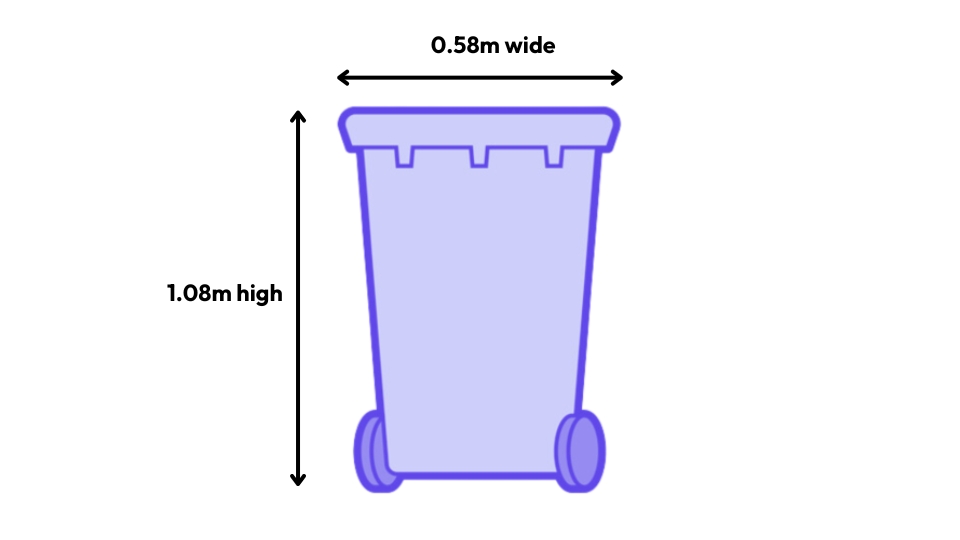
The maximum weight allowance is determined by the waste type a business is disposing of.
- General waste: maximum 15kg
- Dry mixed recycling: maximum 10kg
- Glass waste: maximum 100kg
- Food waste: maximum 100kg
660 Litre Wheelie Bin Specifications
If your business generates an average of 10-12 bags of a given waste type between collections, a 660L wheelie bin will be a good fit.
This ensures each wheelie bin can hold and securely store your waste until collection, which we’ll organise on a schedule that suits you – weekly, fortnightly, or monthly.
- Collection frequency: Weekly, fortnightly, or monthly
- Capacity: 660 litres, or about 12 full bags of waste
- Waste types: General waste, dry mixed recycling
- Lockable lids? Yes (optional)
- Number of wheels: 4
660 Litre Bin Dimensions
660L wheelie bins measure 1.26m wide by 0.72m deep by 1.3m high, including the wheels.
This size is consistent across 660L wheelie bins for different waste types.
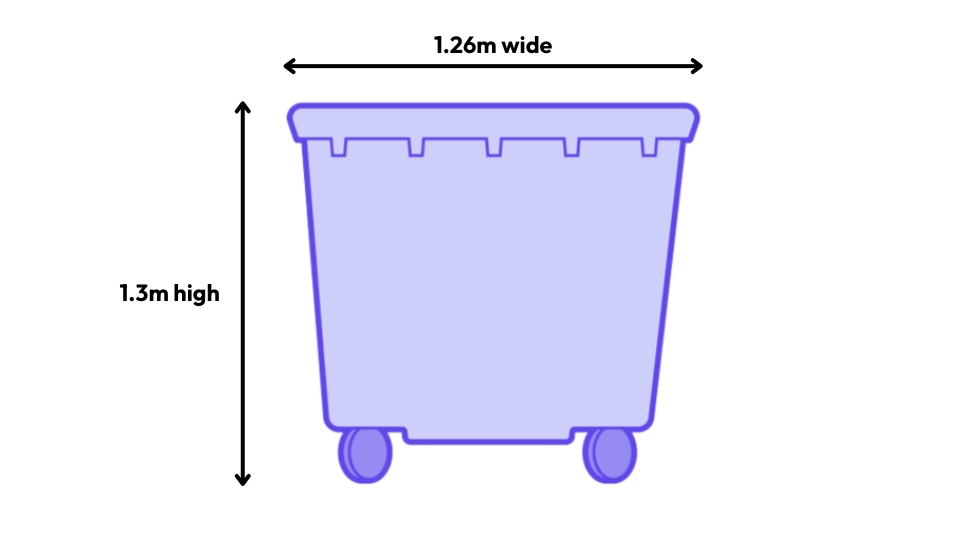
The waste type will determine the maximum weight allowance for your 660L wheelie bins:
- General waste: maximum 40kg
- Dry mixed recycling: maximum 25kg
1100L Wheelie Bin Specifications
We’ll deliver the wheelie bins to you, collect them on your preferred schedule (weekly, bi-weekly, or monthly), and handle all the transportation and disposal.
Need a high-capacity option? Our large 1100L wheelie bins are ideal for businesses that generate a lot of waste. We’ll provide as many as you need, free of charge!
- Collection frequency: weekly, fortnightly, or monthly
- Capacity: 1100 litres, or about 18 full bags of waste
- Waste types: general waste, dry mixed recycling
- Lockable lids? Optional
- Number of wheels: 4
1100L Wheelie Bin Dimensions
Regardless of the waste you need to dispose of, 1100L wheelie bins provide a spacious option with standard dimensions of 1.26m wide, 1m deep, and 1.4m high (including wheels).
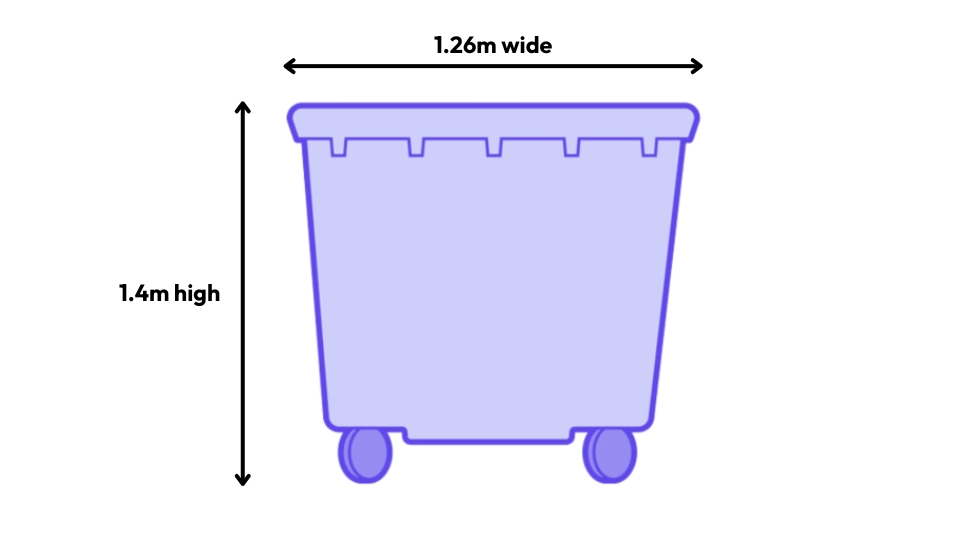
The waste type will determine the maximum weight allowance for your 1100L wheelie bins:
- General waste: maximum 70kg
- Dry mixed recycling: maximum 40kg
How can I check the size of my current wheelie bin?
If you don’t know the size of your current wheelie bin, there are some simple ways to help figure it out. Typically, most bins have the sizing information printed on the bin, including the manufacturer’s name and the capacity in litres (e.g., 240L, 660L, and 1100L). In some cases, a maximum weight limit is also indicated.
Often you can find this information on the lid, along the rim of the opening or near the base on the front/back panel.
If the markings are not visible, you can estimate by measuring the height and width of the bin. Collecting these measurements can help identify if you have a 240L (H:1067-1180mm W:575- 585mm), 660L (H:1160- 1235mm W:1230- 1375mm), or 1100L bin (H: 1325-1365mm W:1365-1380mm). This will help you decide and make sure you choose the right replacement.
Arrange a Collection for Any Size of Your Commercial Wheelie Bin
Explore the wheelie bin sizes we can offer your business and get a free quote today with Waste Managed.
Call us today on 03330529094 and our friendly team will help you create a waste management plan that works for you.
We can recommend the best wheelie bin sizes and collection schedules based on your business’s specific needs, like what type of waste you produce, how much you generate, and the space available on your site.
Waste Managed can arrange reliable waste collections for all different bin sizes, specifically including 240L, 660L and 1100L commercial bins. Whatever your business needs, our team will help you choose the right waste management plan.
We provide reliable waste collection services across the whole of the UK. Explore our locations to see how we can support your business waste management needs, no matter where you are based.
Waste Managed are experts in commercial bin hire
At Waste Managed, we help businesses across the UK with reliable commercial waste collections and the right bin sizes for their needs.
With 14+ years of industry experience and 40,000+ customers, our friendly team helps businesses manage their waste efficiently and compliantly.
Every year we arrange the delivery of thousands of commercial wheelie bins, from smaller 240L containers to larger 660L and 1100L bins for higher waste volumes.
We support businesses across a range of sectors, including offices, hospitality venues, healthcare providers and retail premises.
Let us support your business and help you stay compliant so you can focus on what really matters, running your business.