Fans set to drink 427 million pints this World Cup, creating 2,700 tonnes of plastic waste
This Summer, 73% of the world’s population – that’s 6 billion people, are expected to engage in the 2026 FIFA World Cup. [i] Fans are set to travel from all over the globe to stadiums across the United States, Mexico and Canada for the largest World Cup tournament in history. 48 teams, 104 matches, 16 host cities, three countries – one golden trophy.
But behind every kick, every chant, and every minute of extra time is a stream of waste which is quietly growing. Scientists for Global Responsibility have found that the 2026 FIFA Men’s World Cup Finals are set to be the most polluting World Cup ever, generating 9 million tonnes of carbon dioxide equivalent (MtCO2e) – the same amount produced by nearly 6.5 million average British cars every year.
You don’t need a flight to North America to be part of the problem, however. Here in the UK, audiences are set to sell out fan zones, pack out pubs and host watch along parties, leaving a mountain of waste behind them.
To understand the true scale, we’ve looked at just one match day ritual many fans across the country will be looking forward to: the humble pint. With hundreds of millions set to be poured over the course of the tournament, there’s a staggering amount of waste to be generated. We have broken down the numbers to help put this issue into perspective.
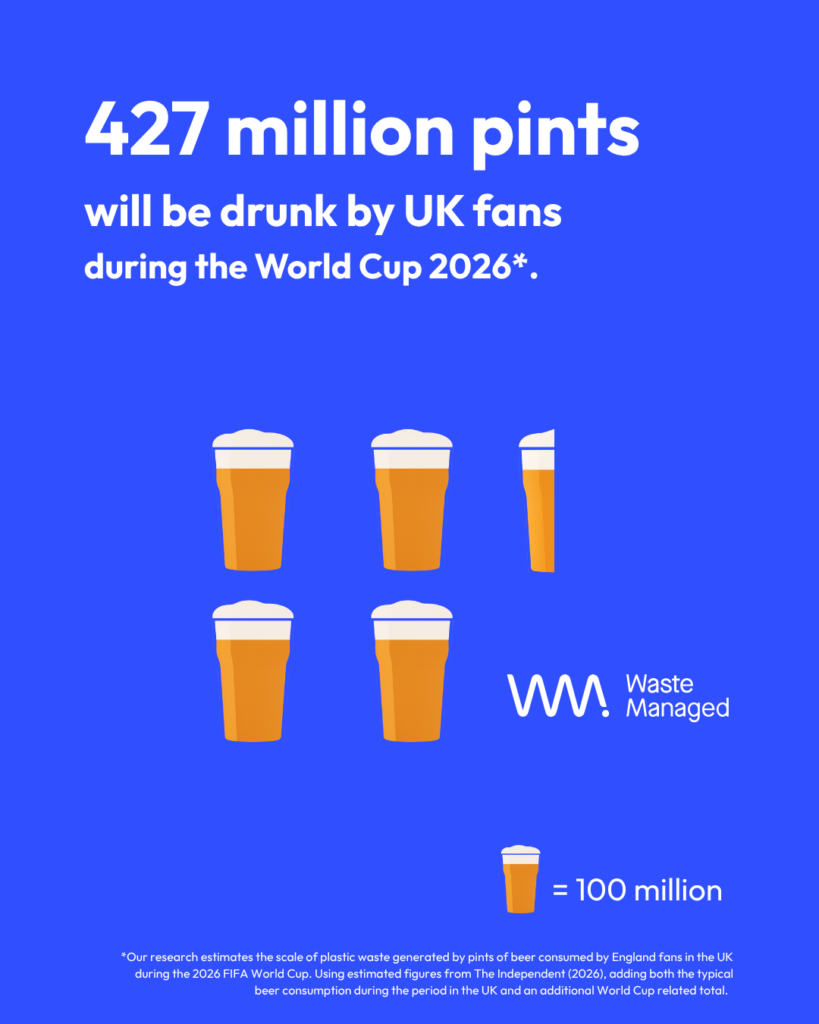
- By our calculations, 427 million pints will be drunk by fans across the UK over the 2026 tournament
- This works out at 10,949,948 pints drunk every day, 456,204 every hour, 7,604 every minute, and 127 every second
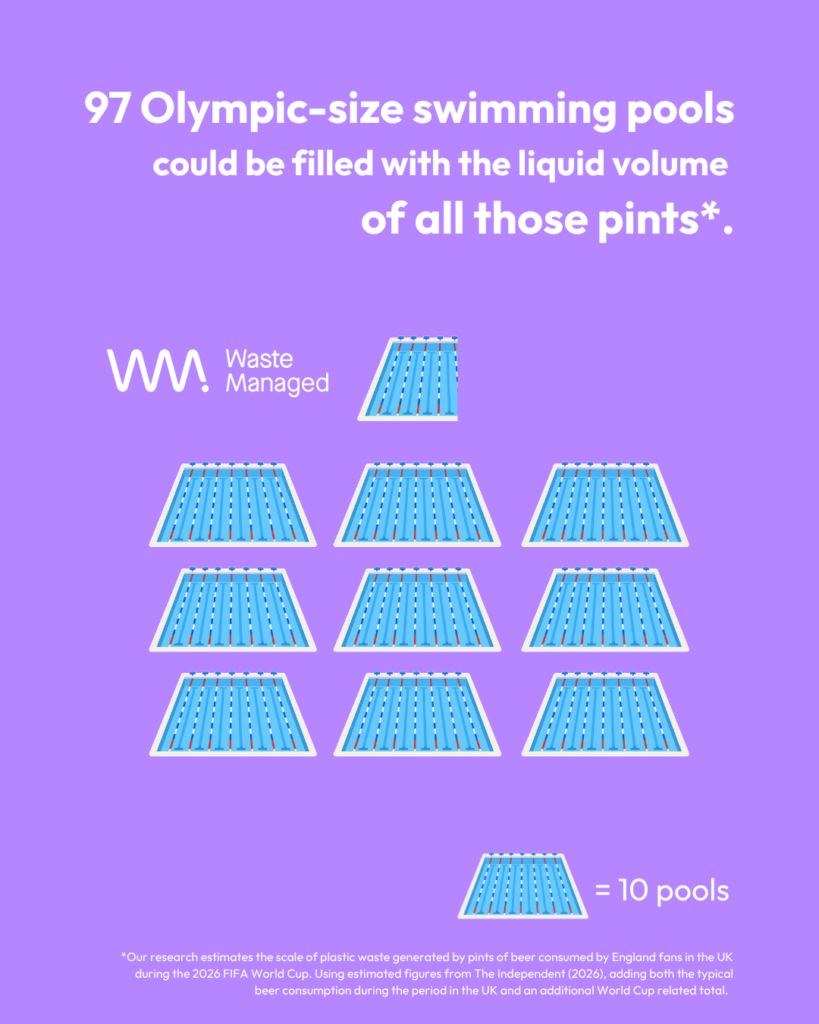
- The combined liquid volume of all those pints would fill 97 Olympic swimming pools
- Because many UK venues serve drinks in plastic cups at major screenings for health and safety reasons, we estimate that virtually every pint will be served in single-use plastic.
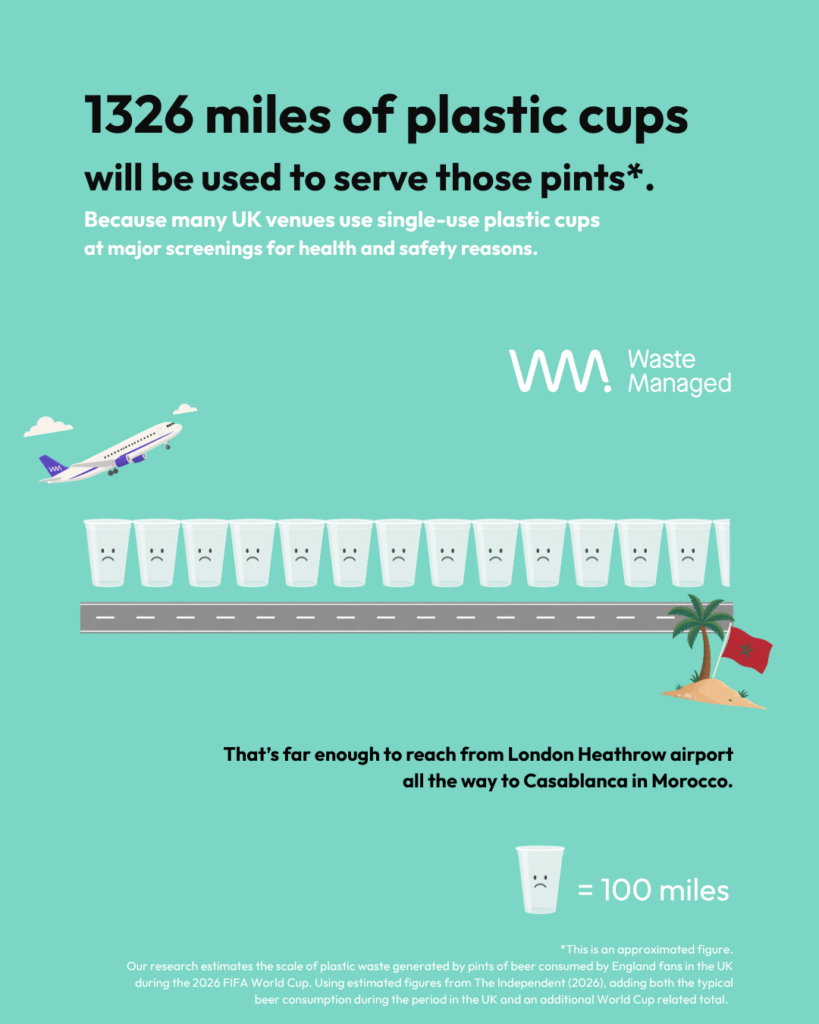
- Stacked end to end, those cups stretch over 1,326 miles
- That’s far enough to reach from London Heathrow airport all the way to Casablanca in Morocco
- We calculate the total weight of these cups to be 2,732.8 tonnes
- To put this into perspective, that’s the equivalent weight of 34 passenger planes
- A typical plastic cup made from polypropylene or PET does not fully biodegrade on human timescales. Instead, the materials usually break down into microplastics and eventually nanoplastics [ii]
- Many plastic cups aren’t recycled properly, and even when they are, they are typically downcycled into lower-grade materials rather than recreated into new cups. This means the material value is gradually lost over time [iii]
Our Group Chief Commercial Officer, Kelvin Croney, shares his thoughts on this issue:
“Most fans won’t give a second thought to what happens to their plastic cups after they finish drinking their pint. It gets chucked in the bin at the pub or a fan zone, and that’s the end of the story. However, the journey of that cup after this depends entirely on the business behind the bin. Under the new Simpler Recycling rules, businesses with over 10 employees must now separate recycling, so every plastic cup should go into a dedicated recycling bin and be free of any liquids or residue. Smaller venues don’t need to comply with this legislation until March 2027; however, I urge every venue regardless of size to not wait. Supporting your country shouldn’t come at the cost of the environment and it’s up to FIFA, fans and businesses to do their bit.”
Update – 7th July 2026 – England vs Mexico sees almost 6 million pints sold in the UK
- The British Beer and Pub Association (BBPA), have confirmed with us that almost 6 million pints were sold on Sunday night (5th July) as fans tuned into watch England play Mexico, an additional 1.25 million more pints sold than normal
- Assuming due to heath and safety reasons those 6 million pints were sold in plastic cups, stacked together, these cups would reach 30,000.135 metres, ≈ 30 km and ≈18.64 miles
- Stacked vertically and to end, this tower of cups would be over three times taller than Mount Everest
- By our calculations, the weight of these cups totals 38,400 kg or 38.4 tonnes – the same weight of 6 adult African elephants
- The average UK household produces around 0.894 tonnes of waste every year, so from plastic pint cups alone, this one match produced the equivalent of 43 households’ worth of annual waste
Methodology
Our research estimates the scale of plastic waste generated by pints of beer consumed by England fans in the UK during the 2026 FIFA World Cup.
We estimated a total of 427 million pints to be consumed between the 11th June and 19th July 2026 using estimated figures, adding both the typical beer consumption during the period in the UK and an additional World Cup related total. In order to create the estimated measurements, we used the standard UK pint measurement of 0.568 litres. This equals 242.5 million litres of beer, or 242,536m³.
To estimate the amount of plastic waste, we assumed each pint was served in a standard disposable plastic pint cup weighing 6.4 grams and measuring 14cm tall. This allowed us to calculate the total weight of cups used, as well as the length they would reach if stacked together.
We also created equivalent comparisons, including Olympic swimming pool equivalents, pints consumed per day, hour, minute and second, and aircraft weight of an Airbus A321 passenger jet. These were calculated using publicly available industry measurements. Figures have been rounded where appropriate.
The distance between London Heathrow Airport to Casablanca in Morocco was calculated using Air Miles Calculator.
England vs Mexico game statistics methodology
- We spoke with The British Beer and Pub Association (BBPA), who confirmed almost 6 million pints were sold by pubs across the UK on Sunday night, an additional 1.25 million more pints than normal
- We used the same methodology described above to calculate the length of 6 million plastic pint cups stacked end to end, which we converted to meters, km and miles and then compared to the height of Mount Everest (8,849 meters – Encyclopaedia Britannica)
- Households’ comparison: We took Defra’s most recent confirmed UK waste figures (2023) and divided this by the ONS’s 2025 UK household count (29.0 million households in the UK), which provides a average annual household waste output of 0.894 tonnes. We divided the estimated 38.4 tonnes of plastic cup waste from the match by this household average, to calculate that the waste generated is equivalent to the annual household waste output of approx. 43 UK households
- We used the same methodology described above to calculate the combined weight of the cups and compared this to the weight of an adult African elephant (6 tonnes – Encyclopaedia Britannica)
Your match day waste sorted. If you’re a hospitality business, reach out for a free, no obligation quote.
FAQs
Yes, under England’s Simpler Recycling Rules, all workplaces with 10 or more employees must separate waste before it is collected into:
- Dry recyclable materials (plastic, metal, glass, paper or card)
- Food waste
- Non-recyclable waste
All businesses with 10 or more employees have a legal duty of care to store waste safely and ensure it is collected by a licensed waste carrier. Smaller businesses with less than 10 employees do not have to comply with this legislation until March 2027.
Ideally, all cups should be rinsed and free of liquid before disposal. For busy periods such as sporting events, venues should plan ahead by briefing staff, increasing recycling bin capacity and arranging more frequent collections.
Costs vary depending on your location, bin size, collection frequency. Reach out to us for more information.
A waste broker can properly review your waste streams, ensuring competitive collection, improve your segregation and tailor disposal contracts to your hospitality business.
Sources
[i] https://www.businessofapps.com/news/73-of-the-world-population-expected-to-engage-with-the-fifa-world-cup-this-summer/
[ii] https://www.sciencedirect.com/science/article/abs/pii/S0048969720371801
[iii] https://dspace.library.uu.nl/items/66a6e09c-eb30-4e6e-bc42-8a00b46a90f1

Lyndsay Close – Head of Marketing
Lyndsay joined Waste Managed in April 2025 and brings with her a wealth of marketing knowledge. With degrees in Advertising, Marketing, and Digital Marketing, and being an Associate Member of CIM, Lyndsay is passionate about sustainability, storytelling, and delivering customer excellence.